Fichas
En el conjunto de fichas
Galaxias y estrellas
-
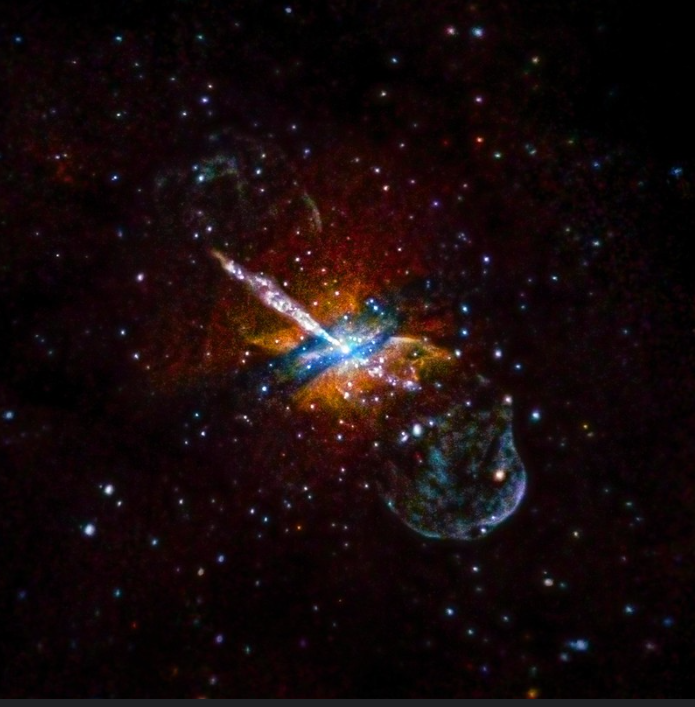 A New Look at an Old Friend Centaurus A is a galaxy well known for a gargantuan jet blasting away from a central supermassive black hole, which is seen in this new Chandra image. This image - where red, medium, and blue show low, medium, and high-energy X-rays respectively - has been processed with new techniques and contains data from observations equivalent to over nine and a half days worth of observing time taken between 1999 and 2012. The data housed in Chandra's extensive archive on Centaurus A provide a rich resource for a wide range of scientific investigations, including a recent study that examines the population and characteristics of black holes and neutron stars throughout the galaxy.
 -
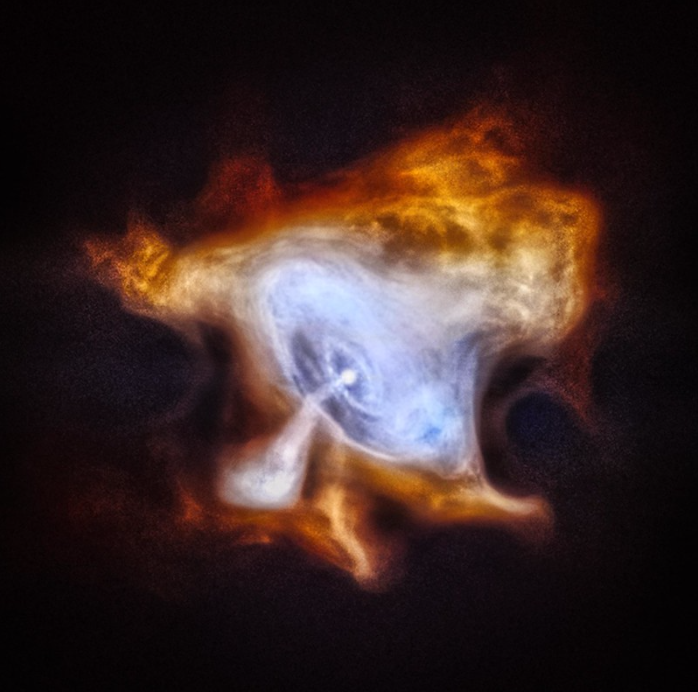 NASA's Chandra X-ray Observatory Celebrates 15th Anniversary In 1054 AD, Chinese astronomers and others around the world noticed a new bright object in the sky. This “new star” was, in fact, the supernova explosion that created what is now called the Crab Nebula. At the center of the Crab Nebula is an extremely dense, rapidly rotating neutron star left behind by the explosion. The neutron star, also known as a pulsar, is spewing out a blizzard of high-energy particles, producing the expanding X-ray nebula seen by Chandra. In this new image, lower-energy X-rays from Chandra are red, medium energy X-rays are green, and the highest-energy X-rays are blue.
 -
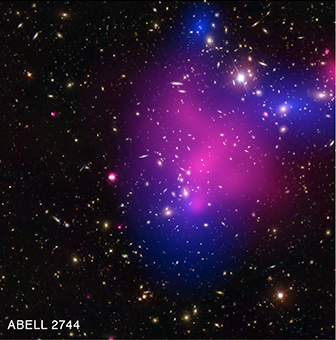 Dark Matter is Darker Than Once Thought 3 These galaxy clusters are part of a large study using Chandra and Hubble that sets new limits on how dark matter - the mysterious substance that makes up most of the matter in the Universe - interacts with itself. The hot gas that envelopes the clusters glows brightly in X-rays detected by Chandra (pink). When combined with Hubble's visible light data, astronomers can map where the stars and hot gas are after the collision, as well as the inferred distribution of dark matter (blue) through the effect of gravitational lensing.
 -
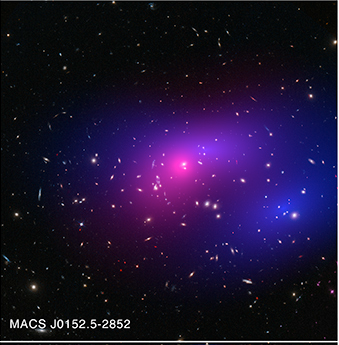 Dark Matter is Darker Than Once Thought 2 These galaxy clusters are part of a large study using Chandra and Hubble that sets new limits on how dark matter - the mysterious substance that makes up most of the matter in the Universe - interacts with itself. The hot gas that envelopes the clusters glows brightly in X-rays detected by Chandra (pink). When combined with Hubble's visible light data, astronomers can map where the stars and hot gas are after the collision, as well as the inferred distribution of dark matter (blue) through the effect of gravitational lensing.
 -
 Dark Matter is Darker Than Once Thought These galaxy clusters are part of a large study using Chandra and Hubble that sets new limits on how dark matter - the mysterious substance that makes up most of the matter in the Universe - interacts with itself. The hot gas that envelopes the clusters glows brightly in X-rays detected by Chandra (pink). When combined with Hubble's visible light data, astronomers can map where the stars and hot gas are after the collision, as well as the inferred distribution of dark matter (blue) through the effect of gravitational lensing.
 -
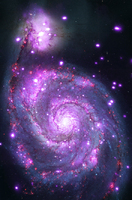 Galaxy Sparkling in X-rays This image contains nearly a million seconds worth of Chandra observing time (purple) along with optical data from the Hubble Space Telescope (red, green, and blue). The X-ray data reveal hundreds of point-like sources, most of which are X-ray binary systems (XRBs) containing a neutron star or black hole in orbit with a star like the Sun. Researchers are studying the XRBs in M51, a.k.a. the "Whirlpool Galaxy," to better understand the role they play in the evolution of the galaxy.